
The ARBED Story Behind Crane Rail (including CR73 Rail)
If you work in crane rail procurement or specification in Australia, the name ARBED turns up on legacy drawings, in supplier literature and in the technical specifications behind some of the most widely used crane rail profiles in heavy industry. The company itself no longer exists as a standalone entity, but the catalogue it built lives on inside ArcelorMittal, and the story of how it came to be is one of the more remarkable chapters in twentieth century European industrial history.
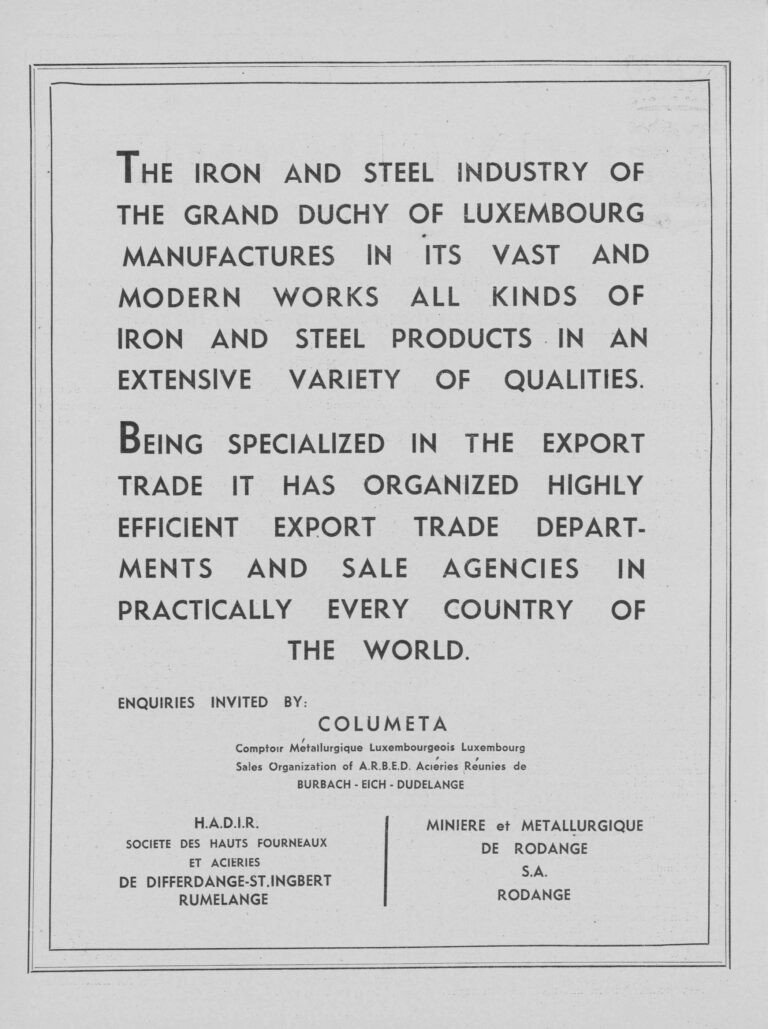
The four letters in ARBED stand for Aciéries Réunies de Burbach-Eich-Dudelange, literally “United Steelworks of Burbach-Eich-Dudelange”. Each name marks one of the original sites: Burbach in the Saar region of Germany, Eich in northern Luxembourg, and Dudelange in the southern Luxembourg minette ore basin. The merger of these three steelworks on 12 July 1911 created what became, for most of the twentieth century, the dominant industrial company in Luxembourg and one of the largest steel producers in Europe.
The ARBED heritage runs through more than a century of European steelmaking and lives on today inside the ArcelorMittal long products and rail programme.
By 1912, the new company was already running 21 blast furnaces, 3 electric furnaces, 2 steelmaking plants and several rolling mills, with annual crude steel output of 824,500 tonnes. That was roughly three-quarters of total Luxembourg production at the time. Within a generation, ARBED was supplying steel rails, structural beams and crane rail across Europe, North Africa, South America and the Pacific.
Where Everything Started
The three founders of ARBED each brought a specific competence to the merger.
The Forges d’Eich, established by the Metz brothers in 1838, brought rolling expertise and the early Thomas-Gilchrist licence that turned the high-phosphorus minette ore of southern Luxembourg into usable structural steel. Norbert Metz, a politician as well as an engineer, was instrumental in bringing Luxembourg into the German Zollverein in 1842, which gave the Metz family’s products tariff-free access to the rapidly industrialising German Confederation.
The Mines du Luxembourg et Forges de Sarrebruck, founded in 1856 by Victor Tesch and a consortium of Belgo-Luxembourg investors, brought the Burbach plant in the Saar. By 1909, Burbach was running eight blast furnaces and producing about 330,000 tonnes of pig iron a year with around 5,100 employees. From the start, Burbach was oriented to long product rolling, particularly rails and structural sections, sold into the booming railway markets of the German Empire.
The Hauts Fourneaux et Forges de Dudelange, established in 1882, was created specifically by the first two companies to industrialise the Thomas-Gilchrist process at scale on Luxembourg ore. The first Thomas charge was blown at Dudelange in 1886.
When these three companies merged in 1911, they did not invent crane rail from nothing. Both Burbach and Eich had been rolling early flat-bottom rail profiles for use on overhead travelling cranes in their own steelworks since the 1880s. What the merger did was consolidate the engineering and the catalogue under one roof, allowing ARBED to develop progressively heavier and more specialised crane rail sections through the interwar and postwar decades.
The Differdange Connection
The other piece of the puzzle is Differdange, just west of Esch-sur-Alzette in southern Luxembourg. On 1 July 1901, the Differdange steelworks became the first plant in the world to hot-roll wide-flange “Grey” beams from a single ingot, seven years before Bethlehem Steel installed its own Grey mill in Pennsylvania. By June 1911, Differdange had rolled the world’s first one-metre-deep wide-flange beam.
Differdange did not start out as part of ARBED. It passed through several owners, including the German industrialist Hugo Stinnes and the Franco-Belgo-Luxembourg consortium HADIR. ARBED acquired a controlling stake in HADIR in 1965 and absorbed it completely in 1967.
The technical know-how needed to roll one-metre Grey beams turned out to be the same family of know-how that produces the largest crane rail profiles. The MRS221 (221 kg/m), MRS192 (192 kg/m) and GCRD183 (183 kg/m) profiles in the current catalogue sit at the practical upper limit of what conventional rail mills can produce, and they exist because the Differdange heavy section culture was eventually absorbed into the ARBED long products programme.
Today, the Differdange site, operated by ArcelorMittal as Long Products Luxembourg, runs a 740,000 tonne per year heavy section “Grey mill” that produces jumbo beams up to 27 tonnes per piece, the world’s largest such sections, supplying skyscrapers, sports stadiums and offshore platforms.
From ARBED to ArcelorMittal
The trente glorieuses, 1946 to 1975, were ARBED’s golden era. Luxembourg crude steel production rose from 2.45 million tonnes in 1950 to 6.45 million tonnes in 1974. ARBED took over HADIR completely in 1967, became a partner in the Belgian Sidmar joint venture from 1962, and developed in 1959 the LD-AC basic oxygen process at Dudelange, an in-house variant of the Linz-Donawitz process specifically adapted to phosphoric Thomas iron.
The 1973 oil shock cut Luxembourg crude steel output sharply, and by 1983 production had fallen back to 1955 levels. Through the 1980s and 1990s, ARBED restructured progressively. In 1978, ARBED took a 25.2 percent stake in the independent Rodange mill, S.A. Métallurgique et Minière de Rodange-Athus, becoming the controlling shareholder and adding the Rodange long products and rail rolling capability to the ARBED catalogue. In 1994, the company announced the strategic shift to electric arc furnace steelmaking, which closed the country’s last blast furnace at Belval in July 1997. The same year, the Rodange and Schifflange operations were consolidated into a new entity called ARES.
In February 2002, ARBED merged with the Spanish company Aceralia and the French company Usinor to form Arcelor. In June 2006, Arcelor merged with Mittal Steel to create ArcelorMittal, the world’s largest steel producer. Through both transitions, the ARBED rail and special sections engineering team in Esch-sur-Alzette was preserved.
Where CR73 Fits
CR73 is one of the special crane rail profiles in the ArcelorMittal catalogue, rolled to Specification CRTS01.5 at 73.30 kg/m. It sits in the broader special crane rail family that includes MRS73, MRS86, MRS87A, AS86, CR100 and CRS140.
The crane rail programme is centred on Train A at the Rodange mill in southern Luxembourg. The Rodange site was originally founded in 1872 by the Collart brothers and Thomas Byrne as the Société Anonyme des Hauts-Fourneaux de Rodange, predating ARBED itself by 39 years. Train A was commissioned in 1907 as a 900mm three-cage duo mill alongside a Thomas steelworks and has been rolling heavy long products continuously since then. The site has had dedicated in-line rail thermal treatment capability since 1949, and the modern Thermal Treatment of Rails (TTR) system was commissioned in 1985. Railway rail production at Rodange ceased around 1990, leaving the heavy section and crane rail capability intact.
CR73 is supplied in 12-metre standard lengths and is widely used in Australian heavy industry for:
- Stacker-reclaimers and ship loaders at iron ore, coal and bauxite ports
- Overhead travelling cranes in steelworks, foundries and rolling mills
- Container gantry cranes on quayside wharves
- Heavy mining infrastructure where equipment runs on fixed crane rail
The profile is dimensionally distinct from the more commonly specified DIN 536 A-series rails (A45, A55, A65, A75, A100, A120, A150) and from the AREMA-style American crane rails. It is not directly interchangeable with any of these, which is why a CR73 substitution decision needs to consider the clip system, pad geometry and end stops as a connected package rather than treating the rail in isolation.
The Bigger Picture
The ARBED story is, in one sense, a national industrial history. From the 1838 founding of the Forges d’Eich, through the 1911 merger, the absorption of Differdange and HADIR in 1967, the postwar growth into one of Europe’s largest steel producers, and the 2002 and 2006 mergers into Arcelor and ArcelorMittal, the same Luxembourg sites have been at the centre of European heavy section rolling for nearly two hundred years.
For Australian procurement managers and engineers, that heritage matters because the modern crane rail catalogue is a direct inheritor of more than a century of customer-driven development at the Luxembourg mills. The technical specifications carry forward institutional knowledge that does not exist in the same form anywhere else in the world. Knowing where a profile comes from, and why it was developed, is part of understanding what you are buying.
Tags: ARBED, Luxembourg, Burbach Eich Dudelange, Differdange Grey beam, Luxembourg steel history, Arcelor merger 2002, Rodange, Train A Rodange, special crane rail, CR73 rail, crane rail heritage, European crane rail, Australian crane rail
More Posts
DIN vs AS vs JIS Rail Profiles: What are they?
When sourcing crane rail for industrial applications, whether for overhead cranes, port terminals or fabrication yards, understanding where your rail is made is essential. The origin of your rail affects not only quality and compliance but also availability, lead times and long-term performance.