World First Free Crane Rail Design Tool (Beta)
We are proud to announce what we believe to be a worldwide industry first. A free, browser-based crane rail system design tool, built specifically for engineers, installers and system designers working on Australian crane rail projects.
No software to install. No licence to buy. No consultant to call for basic information. Just open the tool, enter your project parameters and get a documented preliminary design back in minutes.
The tool is currently in beta. It is live and producing useful preliminary designs for the projects we have tested it against. Any feedback you have while we test multiple scenarios is genuinely welcome. If something does not look right, or if a feature is missing, please tell us and we will work it into the next update.
You can access it right here: Crane Rail Design Tool
What Does It Actually Do?
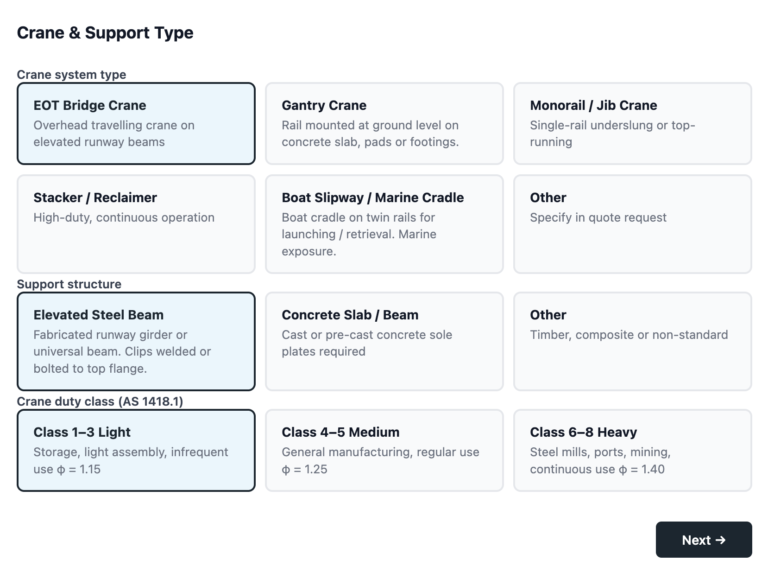
The tool walks you through a four-step process.
First you tell it about your crane system. Whether it is an EOT bridge crane, gantry crane, monorail, stacker reclaimer or boat slipway, what your support structure looks like, and your duty class under AS 1418.1.
Then you enter your loads. Maximum static wheel load per rail in kN, number of wheels, runway length, number of rails and standard supply length. If you have the crane wheel diameter you can enter it too. This unlocks a Hertz contact stress check, which is the primary method engineers use to size crane rail.
Step three lets you select your rail standard. DIN 536 crane rail is the most common choice for new installations in Australia, but the tool also covers JIS E 1101 light rail and AS/NZS 1085.1 standard rail. You can tell it which profile you are working with, or ask it to recommend one for you.
Step four is the output. And it is comprehensive.
- Recommended rail profile with published section properties
- Clip selection with lateral load utilisation check, against published manufacturer lateral resistance values, with crane-type-specific lateral force factors
- Optimised clip spacing across 400 to 800 mm, picking the widest pitch that satisfies both rail bending and clip utilisation checks
- Hertz contact stress check, if wheel diameter is provided
- System accessory flags. Hold-down bolts, fishplates, tie-back links, hot-dip galvanising, thermal expansion considerations, and slipway-specific guidance for marine cradles
- Per-rail and total system bill of quantities, copyable for email or quote submission
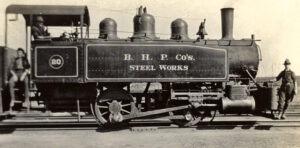
- Obsolete rail replacement reference. Matches BHP, imperial and ASCE legacy profiles to modern equivalents
The tool thinks about the full system, not just the clip.
Hook Bolts Still in Development
One feature we are still developing is full hook bolt design calculations. Hook bolt fastening is a method of securing crane rail to a steel beam or channel. The hook passes through holes drilled in the rail foot and wraps under the beam flange, secured with a nut and lockwasher from above.
It is a legitimate and widely used fastening method, and we wanted to be transparent about it in the tool rather than stay silent. When steel beam support is selected, the tool flags hook bolt fastening as a consideration and invites you to contact us. The full calculation path is still in development and will be added in a future update.
If you are working on a project that involves hook bolt fastening and would like to register your interest, please get in contact with us.
Why Did We Build This?
Honestly? Because we are passionate about crane rail and we think the industry deserves better tools.
We are not just a rail supplier. We are a team of people who genuinely care about this industry. About the engineers who are trying to get a design right, the installers working through the details on site, and the system designers who need answers quickly and accurately.
We have always tried to be a resource, not just a catalogue. Our phone gets answered. Our team knows the products. And now we have put that knowledge into a tool that anyone can use, any time, for free.
We believe this is the first tool of its kind in the world from a crane rail supplier. That is something we are genuinely proud of, and it is not a line we throw around lightly.
This Is Just the Beginning
The tool is live, but we are not done. We are committed to continuing to develop and improve it based on feedback from the people who use it. There are other features we are already working on.
If you use the tool and have a suggestion, or if you think something is missing, or if you find something that does not look right, please contact us. We genuinely want to hear from you. Every piece of feedback we receive goes into the next update, especially while we are testing multiple scenarios in beta.
A Note on Results
The tool is a preliminary design aid in beta. All results must be verified by a qualified engineer before procurement or installation. Inform Rail accepts no responsibility for designs based solely on the output of this tool. That is not just boilerplate. It reflects the reality that every project is different, and the tool is a starting point, not a final answer.
That said, for what it does, giving engineers, installers and system designers a fast, structured, documented preliminary design, we think it is genuinely useful. Go have a look.
Tags: Crane rail design, AS 1418, DIN 536 crane rail, AS/NZS 1085.1, Inform Rail, Australian crane rail, Hertz contact stress, gantry crane design, stacker reclaimer, crane rail clips