Okay so that’s briefly what fishplates are, what important functions do they serve?
- Maintaining alignment between rail sections
- Transferring vertical and horizontal loads across the joint
- Allowing for thermal expansion and contraction
- Facilitating easy replacement of rail segments without welding
Fishplates are essential in crane rail systems where continuous welded rail is not used or where modular installation is preferred.
Australian Standard Fishplates
In Australia, fishplates are manufactured to match Australian Standard rail profiles, including:
- AS 41kg
- AS 47kg
- AS 50kg
- AS 53kg
- AS 60kg
- AS 68kg
These fishplates are designed to fit the specific dimensions and tolerances of each rail type. They are typically supplied with matching sleeper plates and fasteners (nuts and bolts), forming part of a complete rail joint system.
Inform Rail can supply:
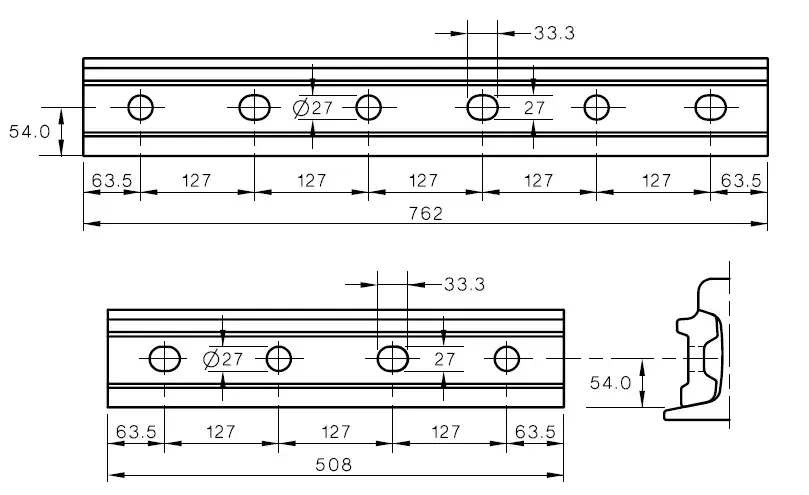
- Standard fishplates (4-hole & 6-hole)
- Junction fishplates for connecting different rail sizes.
- Special-length fishplates for bridges and high-load rail applications.
- Bowed fishplates for temporary use before welding.
- Crane Rail fishplates. such as: 73Kg & 86Kg
4-Hole and 6-Hole Fishplates
Fishplates are commonly available in 4-hole and 6-hole configurations:
- 4-hole fishplates are used in lighter-duty applications or where shorter rail sections are installed. They are easier to install and require fewer fasteners.
- 6-hole fishplates provide greater strength and load distribution, making them suitable for heavier-duty crane rail systems or longer rail sections. The additional bolts help reduce stress concentration and improve joint stability.
The number of holes corresponds to the number of bolts used to secure the fishplate to the rail, and the choice between 4-hole and 6-hole depends on the rail profile, load conditions, and installation environment.
Compatibility Beyond Australian Standard
While Australian Standard fishplates are designed for local rail profiles, Inform Rail can supply fishplates for all major international rail profiles, including DIN, JIS, UIC, and custom specifications. Fishplates can be manufactured and supplied according to the required standard, ensuring compatibility with crane rail systems used in global infrastructure projects.
Trusted Supply and Support
Inform Rail works with one of the most reputable fishplate manufacturers in the country – an Australian-owned company with over 50 years of experience in metal supply and engineering. This longstanding partnership ensures that fishplates supplied through Inform Rail meet the highest standards of quality, compatibility, and compliance with Australian and international specifications.
For project-specific guidance, including compatibility with rail profiles and accessories, it is recommended to consult Inform Rail. They can provide:
- Fishplate specifications
- Bolt kits and sleeper plates
- Installation instructions
- Compliance with AS and international standards
At Inform Rail, we’re proud to lead the way in crane rail and standard rail supply across Australia. Whether you’re a graduate engineer finding your feet or a managing director overseeing major infrastructure, we’re always up for a chat and ready to take on any challenge. We bring deep technical know-how and the kind of old-school service that still matters. If you’ve got a project in mind or just want to explore what’s possible, we’re here and keen to help.