What does ASCE stand for?
ASCE stands for the American Society of Civil Engineers. In rail, the term refers to the standard tee rail sections the Society adopted on 2 August 1893, when its Committee on Standard Rail Sections delivered its final report.
Why was the standard created?
Before 1893, railway engineers drew their own rail sections. Close to 300 different patterns were in use across the United States, which forced mills to hold large stocks of rolls and run costly special orders. The ASCE sections replaced that with one family of profiles built to the same proportions.
What are the design rules?
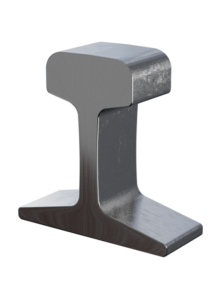
Every ASCE section follows the same geometry. The base width equals the rail height, and the steel is distributed 42% to the head, 21% to the web and 37% to the base. The original report covered 13 sections from 40 to 100 lb/yd in 5 lb steps. Mills later applied the same proportions to lighter sections, which is where ASCE 12 through ASCE 35 come from.
What happened to ASCE rails?
Main line railways outgrew the ASCE design as axle loads increased. The American Railway Association issued new sections in 1909, and heavier profiles followed between 1919 and 1924. Those became the modern AREMA sections such as 136RE, which we have previously written about. The ASCE sections stayed in production for lighter duty, and they remain standard for crane runways, mine track, transfer tables and industrial sidings.
The Society itself is still active. Today it is best known for its Report Card for America’s Infrastructure.
ASCE Rail Profiles
The ASCE family has 18 sections, from 12 lb/yd to 100 lb/yd. The table below lists each one with metric dimensions converted from the imperial section data.
| Section | kg/m | Height (mm) | Base (mm) | Head (mm) | Web (mm) |
|---|
| ASCE 12 | 5.95 | 50.80 | 50.80 | 25.40 | 4.76 |
| ASCE 16 | 7.94 | 60.33 | 60.33 | 29.77 | 5.56 |
| ASCE 20 | 9.92 | 66.68 | 66.68 | 34.13 | 6.35 |
| ASCE 25 | 12.40 | 69.85 | 69.85 | 38.10 | 7.54 |
| ASCE 30 | 14.88 | 79.38 | 79.38 | 42.86 | 8.33 |
| ASCE 35 | 17.36 | 84.14 | 84.14 | 44.45 | 9.13 |
| ASCE 40 | 19.84 | 88.90 | 88.90 | 47.63 | 9.92 |
| ASCE 45 | 22.32 | 93.66 | 93.66 | 50.80 | 10.72 |
| ASCE 50 | 24.80 | 98.43 | 98.43 | 53.98 | 11.11 |
| ASCE 55 | 27.28 | 103.19 | 103.19 | 57.15 | 11.91 |
| ASCE 60 | 29.76 | 107.95 | 107.95 | 60.33 | 12.30 |
| ASCE 65 | 32.24 | 112.71 | 112.71 | 61.12 | 12.70 |
| ASCE 70 | 34.72 | 117.48 | 117.48 | 61.91 | 13.10 |
| ASCE 75 | 37.20 | 122.24 | 122.24 | 62.71 | 13.49 |
| ASCE 80 | 39.68 | 127.00 | 127.00 | 63.50 | 13.89 |
| ASCE 85 | 42.17 | 131.76 | 131.76 | 65.09 | 14.29 |
| ASCE 90 | 44.64 | 136.53 | 136.53 | 66.68 | 14.29 |
| ASCE 100 | 49.61 | 146.05 | 146.05 | 69.85 | 14.29 |
Weights are nominal. Some mills publish ASCE 85 at 85.27 lb/yd, or 42.30 kg/m. Always check the mill certificate and section drawing for the rail being supplied before detailing clips, fish plates or wheel profiles.
What are some of the ways ASCE rail is referred to?
Suppliers and drawings use several formats for the same section. ASCE 60 can appear as ASCE60, 60 lb ASCE, 60# ASCE, 60AS or 6040, which is the section index used in American rail tables. If a drawing shows any of these, it is the same profile.
What does the number mean?
The number in an ASCE designation is the rail weight in pounds per yard. To convert to kilograms per metre, multiply by 0.496. ASCE 60 is therefore 29.76 kg/m and ASCE 80 is 39.68 kg/m.
What are the steel grades?
ASCE rail is supplied by hardness. Standard carbon grades start at about 201 HB for most sections, with harder grades of 260 HB and above available in ASCE 60 and heavier. Harder grades resist head wear for longer under repeated wheel loads, so tell us the wheel load and duty cycle when you enquire and we will recommend a grade to suit.
What are the standard lengths?
Mills typically roll ASCE rail in 10 m and 12 m lengths. Shorter lengths can be cut to order, and rail ends can be supplied blank for welding or drilled for fish plates.
Where is ASCE rail used?
ASCE rail is used wherever a wheel load needs a rail but the duty does not call for a heavy main line or crane rail section. Mining was the earliest adopter, and the profiles are still the standard choice for light industrial track in North America.
What are the lighter sections used for?
ASCE 25 to ASCE 40 suit materials handling, overhead crane runways and some hard rock mining track. They are also common on hangar doors, car wash systems, assembly lines and automated warehouse storage and retrieval systems.
What are the heavier sections used for?
ASCE 60 to ASCE 85 carry tunnelling equipment, mine haulage and heavier crane runways. Major American suppliers list ASCE sections from 12 lb to 80 lb for overhead, gantry and portal cranes, stacker reclaimers and rail mounted tower cranes.
What is used above 100 lb/yd?
Main line and heavy haul work has moved to AREMA sections such as 115RE and 136RE. For heavy cranes the usual step up is to a dedicated crane rail.
Is ASCE rail common in Australia?
ASCE rail is not as common in Australia as it is in the United States, Canada and Latin America. Australian engineers usually order light rail by its kilogram weight, so the letters ASCE rarely appear on a local drawing.
Where does ASCE rail turn up in Australia?
We see it most often on imported cranes and plant where the wheels were designed around an ASCE head, on older equipment that needs a like for like rail replacement, and on mine, tunnel and port projects designed overseas.
Is ASCE rail interchangeable with other rail?
Not always. Two rails with a similar weight per metre can differ in height, head width and base width. A few millimetres is enough to stop clips seating, fish plates lining up or wheels running properly on the head. Before you order replacement rail or fastenings, contact Inform Rail with your drawing or the measured height, base and head of the existing rail. We will confirm the section and tell you what will and will not fit.
How Inform Rail stocks and supplies ASCE rail in Australia
Inform Rail supplies ASCE rail anywhere in Australia, from stock where the section is common here and direct from the mill where it is not.
What do we hold in stock?
We stock the ASCE sections that Australian industry uses most. Stock is held at our Brisbane warehouse, with storage capability in Perth for Western Australian projects.
Do we supply fastenings to suit?
Yes. Rail is only half the system. We supply the clips, fish plate kits, hook bolts, sole plates and pads to suit each ASCE section, so the rail and fastenings arrive as one matched package.
How do I get a price?
Send us the section, quantity, length and delivery location and we will come back with a quote. If you only have an old drawing or a worn rail, send a photo with the height, base and head measurements and we will identify the section for you.
Email sales@informsteel.com.au
Frequently asked questions
What is ASCE 60 rail? ASCE 60 is a flat bottom rail weighing 60 lb/yd, or 29.76 kg/m. It is 107.95 mm high, 107.95 mm wide at the base, 60.33 mm wide at the head and has a 12.30 mm web.
What does the number in ASCE rail mean? The number is the weight of the rail in pounds per yard. Multiply by 0.496 to get kilograms per metre.
What is the difference between ASCE rail and AREMA rail? ASCE sections date from 1893 and have a height equal to the base width. AREMA sections such as 115RE and 136RE came later, are taller relative to their base and are designed for main line and heavy haul loads.
Can I get ASCE rail in Australia? Yes. Inform Rail supplies ASCE rail Australia wide, from Brisbane stock for the common sections and to order for the rest of the range.
What standard is ASCE rail made to? The profiles follow the 1893 ASCE sections. Sections of 60 lb/yd and over are covered by ASTM A1, the specification for carbon steel tee rails.